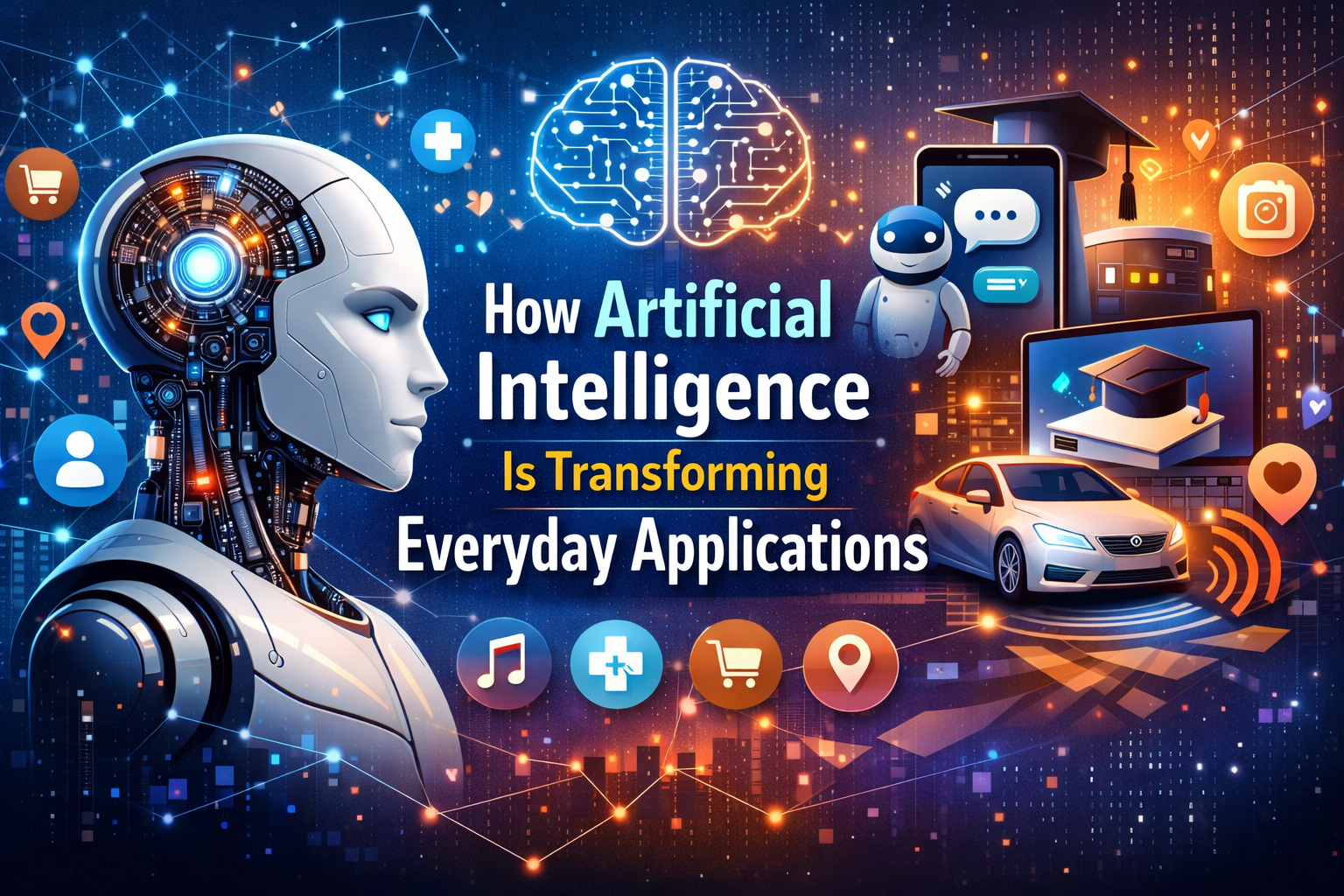
Artificial Intelligence (AI) is no longer a concept limited to science fiction or advanced research labs. Today, AI is deeply integrated into our everyday lives, powering applications we use at home, at work, and on our mobile devices. From voice assistants to smart recommendations, AI is quietly transforming how we interact with technology and improving efficiency across industries.
In this blog, we explore how Artificial Intelligence is revolutionizing everyday applications and shaping the future of digital experiences.
What Is Artificial Intelligence?
Artificial Intelligence refers to computer systems designed to perform tasks that normally require human intelligence. These tasks include learning from data, recognizing patterns, understanding natural language, making decisions, and solving problems.
Modern AI systems rely on technologies such as:
- Machine Learning (ML)
- Natural Language Processing (NLP)
- Computer Vision
- Deep Learning
AI in Everyday Applications
1. Smart Assistants and Voice Technology
Voice assistants like Siri, Google Assistant, and Alexa use AI to understand spoken language and respond intelligently. They help users:
- Set reminders and alarms
- Control smart home devices
- Answer questions
- Perform hands-free tasks
AI-powered voice recognition continues to improve, making interactions more natural and accurate.
2. Personalized Recommendations
AI plays a major role in recommendation systems used by platforms such as:
- Netflix and YouTube (content recommendations)
- Amazon and Daraz (product suggestions)
- Spotify (music playlists)
By analyzing user behavior, preferences, and browsing history, AI delivers personalized experiences that save time and increase engagement.
3. AI in Smartphones and Mobile Apps
Modern smartphones rely heavily on AI for features like:
- Face and fingerprint recognition
- Camera enhancements (portrait mode, night mode)
- Battery optimization
- Predictive text and autocorrect
These AI-powered features enhance usability while improving device performance.
4. Healthcare Applications
AI is transforming healthcare by improving diagnosis and patient care. Some common applications include:
- Medical image analysis (X-rays, MRIs)
- Predictive health monitoring
- Chatbots for basic medical advice
- Appointment scheduling systems
AI helps doctors make faster and more accurate decisions, ultimately saving lives.
5. AI in Education
In education, AI-powered applications are making learning more personalized and accessible. Examples include:
- Intelligent tutoring systems
- Online learning platforms with adaptive content
- Automated grading and assessments
- Virtual teaching assistants
Learning Management Systems (LMS) increasingly use AI to track student progress and recommend learning paths.
6. Business and Office Automation
AI is improving workplace productivity by automating repetitive tasks such as:
- Email filtering and spam detection
- Document processing
- Customer support chatbots
- Sales forecasting and analytics
Businesses benefit from reduced operational costs and faster decision-making.
7. Smart Homes and IoT
AI-powered smart home devices are becoming common in households. These include:
- Smart thermostats
- Security cameras with face detection
- Automated lighting systems
- Energy usage optimization tools
AI allows these systems to learn user habits and respond intelligently.
8. Transportation and Navigation
Navigation apps like Google Maps and ride-sharing platforms use AI to:
- Predict traffic conditions
- Optimize routes
- Match drivers and passengers
- Improve safety through driver monitoring
AI also plays a key role in the development of self-driving vehicles.
Benefits of AI in Everyday Life
- Improved efficiency and productivity
- Personalized user experiences
- Faster and more accurate decision-making
- Cost reduction for businesses
- Enhanced convenience and accessibility
Challenges and Ethical Considerations
Despite its advantages, AI also presents challenges such as:
- Data privacy and security concerns
- Bias in AI algorithms
- Job displacement due to automation
- Dependence on technology
Responsible AI development and proper regulations are essential to address these issues.
The Future of AI in Everyday Applications
As AI continues to evolve, we can expect even deeper integration into daily life. Future applications will be more intelligent, context-aware, and human-centric. AI will not replace humans but will work alongside them to enhance creativity, productivity, and problem-solving.
Conclusion
Artificial Intelligence is transforming everyday applications in ways we often don’t notice but rely on constantly. From smartphones and education to healthcare and business, AI is reshaping the digital world. Understanding its impact helps individuals and organizations prepare for a smarter, more connected future.